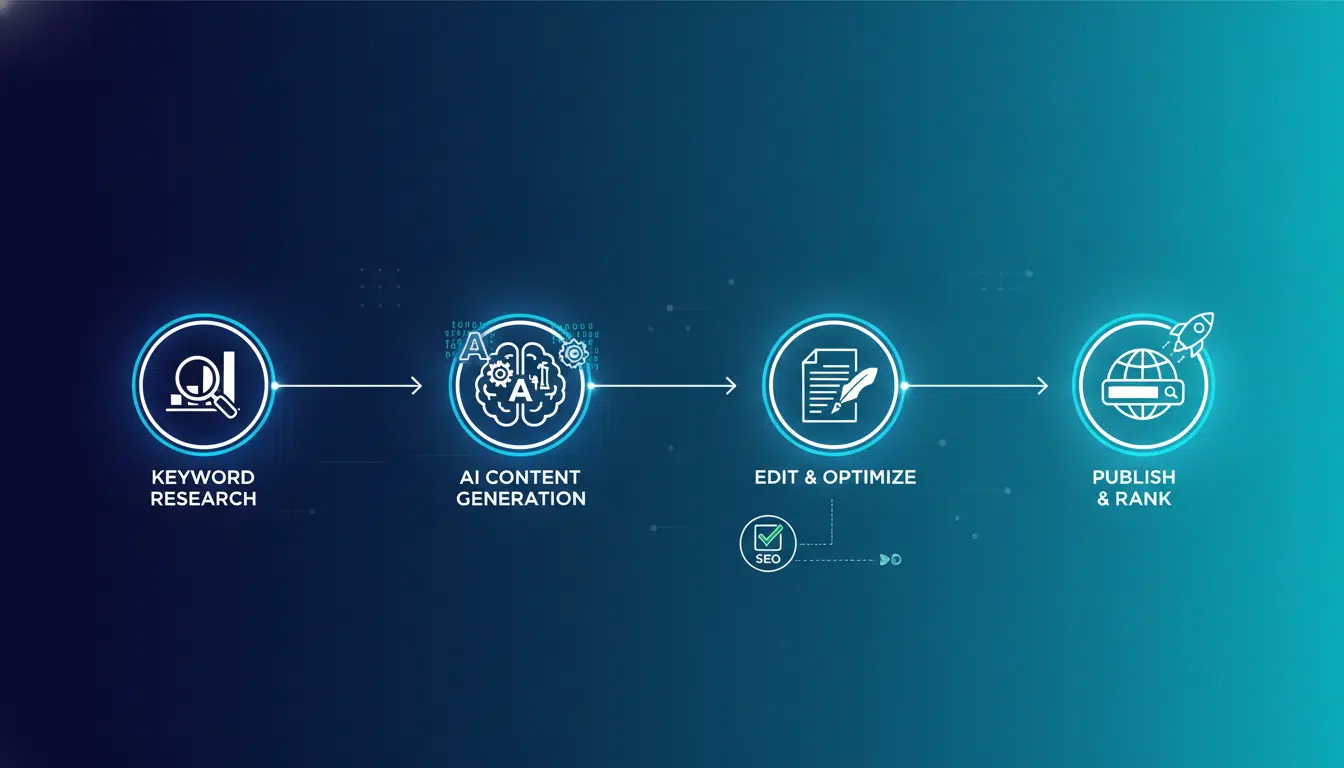
AI Content Workflow for SEO: 7 Steps to Scale Content
Scaling a blog without sacrificing article quality or search engine rankings is one of the toughest challenges in digital marketing today. Artificial intelligence can produce drafts in seconds, but publishing raw output leads to factual errors, generic advice, and potential search engine penalties. To succeed, you need a repeatable process that pairs machine efficiency with human expertise.
In this guide, you will learn how to build an end-to-end ai content workflow for seo that scales your output while maintaining top-tier quality. Follow these seven practical steps to streamline research, drafting, editing, and optimization.
What is an AI Content Workflow for SEO?
An ai content workflow for seo is a structured 7-step pipeline that combines artificial intelligence tools with human editorial review. It automates keyword research, outline generation, and initial drafting while leveraging human experts for fact-checking, brand voice, and optimization to scale high-ranking blog posts safely.
Why Your Blog Needs an AI Content Pipeline
Publishing high-quality content consistently requires significant time and effort. Traditional content generation methods often struggle to meet modern publishing demands because writer burnout and high production costs create bottlenecks. Building an automated ai content pipeline removes these hurdles by standardizing every phase of creation.
By establishing a standardized ai seo writing process, your team achieves three main advantages:
- Increased Output: Produce twice as many published articles per month without expanding your core editorial headcount.
- Consistent On-Page SEO: Ensure every single piece meets target keyword requirements and search intent standards automatically.
- Cost Efficiency: Lower total cost per article while preserving capital for strategic growth and promotion.
However, automation alone is not enough. Search engines like Google focus heavily on E-E-A-T (Experience, Expertise, Authoritativeness, and Trustworthiness). For more background, consult Google’s official search guidance on AI-generated content.

Step 1: Identify Low-Competition Keywords and Search Intent
Every successful article begins with rigorous keyword analysis. Relying blindly on automated topic generators without validation often targets terms that are far too competitive or completely irrelevant to your audience.
Start by identifying long-tail primary keywords with manageable difficulty scores. When planning your editorial calendar, consider these core search intent categories:
| Search Intent | User Goal | Target Content Type |
|---|---|---|
| Informational | Learn a specific concept or fix an issue | How-to guides, tutorials, explainer posts |
| Commercial | Investigate options before making a decision | Tool roundups, product comparisons, reviews |
| Transactional | Purchase a product or sign up immediately | Landing pages, pricing calculators, sales pages |
Match your primary keyword with 3 to 5 secondary semantic terms. This helps search engine crawlers understand topic depth without repeating the primary keyword excessively.
Step 2: Generate Comprehensive Outlines with AI Tools
Do not ask AI software to write a complete post in a single prompt. Doing so usually results in superficial summaries, missing subtopics, and repetitive phrasing. Instead, use your language model to build a structured outline first.
Feed top search engine results into your tool to identify common headings, table structures, and content gaps. Evaluate what top pages are missing, such as real-world examples, step-by-step checklists, or original diagrams.
When selecting your generation tools, check our detailed review of the best AI copywriting software to pick options that match your publishing needs.
Step 3: Draft Section by Section for Higher Precision
To keep control over tone and depth, execute your drafting process section by section. Feed specific prompts for each H2 and H3 heading rather than generating 1,500 words at once.
When drafting each section, enforce these formatting guidelines:
- Keep paragraphs short, between 2 and 4 sentences max.
- Use bullet points to list steps or key highlights clearly.
- Apply bolding on critical key phrases to boost reader scanning speed.
- Avoid fluff adjectives and repetitive introductory statements.
Sectional drafting ensures that each subtopic receives adequate depth and prevents the software from hallucinating false statistics.
Step 4: Implement Human-in-the-Loop Editing
This phase represents the core engine of sustainable publishing. Relying on human in the loop ai content workflows ensures that every draft receives expert oversight before going live on your site.

Human editors must focus on four mandatory checks during review:
- Fact Verification: Validate all external stats, dates, software names, and claims against verified sources.
- Brand Voice Matching: Align tone, terminology, and style with your brand guidelines.
- Detection and Humanization: Smooth out robotic cadence. If you are concerned about search signals or academic filters, learn how to humanize AI content for SEO effectively.
- Unique Insights: Inject personal experience, real case studies, or proprietary screenshots.
Testing your text against detection algorithms gives helpful feedback on syntax repetition. You can read our hands-on GPTZero review and test results or check our analysis on AI generator detection capabilities to understand how detectors operate.
Step 5: Optimize Content with On-Page SEO Software
After your text is polished by an editor, pass it through an ai content optimization tool like Rank Math, Surfer SEO, or Frase. These tools compare your word count, keyword frequency, and heading structure against top ranking competitors.
Key on-page SEO tasks to finalize before publishing include:
- Title Tag: Place primary keyword near the front (keep total length between 50 and 60 characters).
- URL Slug: Keep it short, lowercase, and hyphenated (e.g.,
ai-content-workflow-seo). - Meta Description: Craft a compelling snippet (150 to 160 characters) with a clear call to action.
- Internal Linking: Insert 3 to 5 internal links to relevant past articles using descriptive anchor text.
Step 6: Add Rich Visual Assets and Schema Markup
Text alone is rarely enough to secure top search rankings today. Visual content increases dwell time and keeps visitors engaged on your page longer.
When working on scaling blog content with ai, include these visual elements:
- Featured Image: Custom graphic that reinforces your article topic.
- Body Visuals: Process flowcharts, infographics, or comparative tables.
- Descriptive Filenames and Alt Text: Name image files with descriptive hyphens and write alt text under 125 characters.
In addition, wrap your FAQ section in structured JSON-LD schema or clean HTML blocks. Schema markup helps search engines display rich snippets directly in search engine result pages.
Step 7: Publish, Monitor, and Refresh Content Regularly
Publishing your post is not the final step. To maintain long-term search dominance, monitor your rankings in Google Search Console and analytics dashboards closely.
Follow this post-launch schedule for maximum growth:
- Week 1 to 4: Check indexing status and initial keyword positions.
- Month 3: Review impression data and add missing secondary search terms.
- Month 6: Perform a content refresh, update outdated data, and add fresh internal links.
For strategic insights on industry trends, explore analysis on Search Engine Land to stay informed on algorithm shifts.
Frequently Asked Questions
Will Google penalty websites for using AI content workflows?
No. Google officially ranks content based on quality, relevance, and user value, regardless of how it is created. However, spammy or unedited AI text that lacks value can trigger search penalties.
How many articles can I publish per week with an AI pipeline?
With a trained human editor overseeing your workflow, a single creator can publish 5 to 10 high-quality, fully optimized articles per week without compromising accuracy or depth.
What is the most important step in an AI content workflow?
Human editorial review is the most critical step. Human oversight catches hallucinated facts, refines style, adds personal experience, and ensures compliance with search engine guidelines.
Do I need expensive SEO tools to build an AI content workflow?
No. You can start with free AI models and built-in plugins like Rank Math. As your traffic grows, you can invest in dedicated optimization software to accelerate research.
Build Your AI Content System Today
Creating a streamlined ai content workflow for seo is the single best strategy for scaling your organic search traffic in 2026. By pairing intelligent generation tools with expert human editorial oversight, you get speed without sacrificing quality.
Ready to level up your blog publishing output? Audit your existing content process, implement these seven steps, and start scaling your organic rankings today!